This edition of “Timely Innovations” is about movements. We are talking about ideas that have caught on and made a national or international impact. We are going to look back in time at the origins of playgrounds and how their success then may be a part of some of today’s problems. Next we are going to look at an international effort to re-forest a massive swathe of the continent of Africa. Lastly, we are going to take a quick temperature check on something The Hatchery has been following for a few years: union in the United States.
Where Have all the Playgrounds Gone?
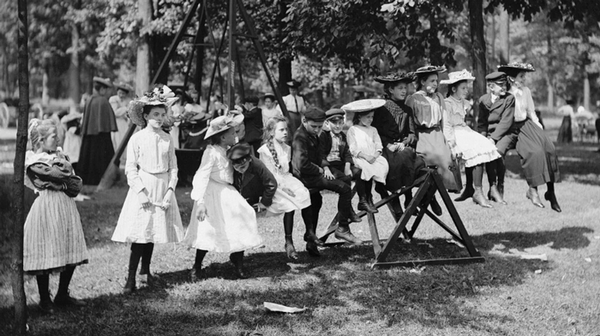
This past spring we had a national mini-panic about teen takeovers. Large groups of young people were congregating in public places and causing a great deal of concern, especially when these gatherings turned violent. In many ways, this is an old problem. Back in 1885, Boston physician Marie Zakrzekska was concerned about children roaming the city unsupervised. This seemed bad for the kids and bad for the city. She imported German educator Friedrick Fröbel’s sandboxes to the states and the first U.S. playground was born. Fast forward nearly 40 years and the aspirations of the playground were much higher according to the relatively new Playground Association of America, “If you want 20 years hence a nation of strong, efficient men and women, a nation in which there shall be justice and square dealing, work it out today with the boys and girls on the playground.” Ironically, today’s kids are returning to the late 1800’s unsupervised public congregating, in part because of the incredibly high standards placed on their play which has created few outlets for them to simply be kids.
The Power of a Shared Problem
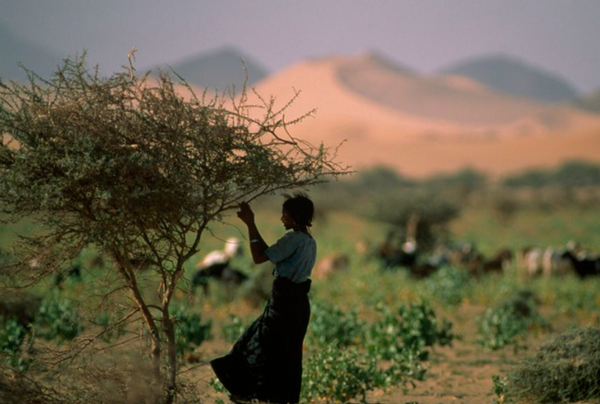
Crossing the Atlantic, there is a massive, international effort to re-forest 11 countries, “Djibouti, Eritrea, Ethiopia, Sudan, Chad, Niger, Nigeria, Mali, Burkina Faso, Mauritania, and Senegal—have joined to combat land degradation and restore native plant life to the landscape.” In Senegal alone, 50,000 acres of trees have been planted. A key driver of this initiative is that while there is a shared, overarching goal, the individual players bring their own approaches and own goals to the table, rather than a top-down approach, “The initiative uses an ‘integrated landscape approach’ that allows each country to address land degradation, climate change adaptation and mitigation, biodiversity, and forestry within its local context… Each participating country has its own individual goals, which include reducing erosion, diversifying income, increasing crop yield, and improving soil fertility.” This was one of the counter-intuitive insights at the core of Adam Kahane’s book, Collaborating with the Enemy. When building complex partnerships, it’s less important for collaborators to agree about THE problem than it is to get them to agree that there is A problem. This can lead to experiments to address concerns that impact all parties.
Labor's Long Comeback
Our final stop on this movement tour is with an effort that is only beginning to pick up steam here in the U.S. Or, perhaps more accurately, a movement that is beginning a comeback. Union approval has been climbing since the mid-2010’s, reaching levels not seen since the 1960’s. There have been numerous successful actions over the past few years and the wheels of public policy are beginning to turn at the federal level. Last week, “a sizable bloc of Republicans, including several from competitive districts who are slogging through tough re-election fights, joined with Democrats to push through a pro-union bill. It would impose an initial 90-day deadline on contract negotiations for new unions and their employers, along with paths to mediation and arbitration if the parties reach an impasse.” Obviously this bill has quite a climb in front of it before it becomes law but it is yet another tangible sign of a pro-worker vibe that is becoming harder and harder to ignore.