All of us have beliefs and activities that are justified by common sense, inherited wisdom, and best practice. You have to! You can’t go around independently validating everything you believe. You wouldn’t get anything done. The question is, what do you do when that common sense gets challenged? Today’s “Timely Innovations” looks at three cases where innovators had to deal with data that didn’t fit in their paradigm and how they rose (or didn’t) to that challenge. Perhaps seeing their blind spots will help you see your own.
The Ice Cream Paradox
Ice cream lovers, rejoice! Everyone’s favorite summer dessert was recently announced to be correlated with “a lower risk of developing type 2 diabetes.” It’s more effective in this than milk. Here is what is strange; researchers have been finding this for almost 20 years. What researchers have been doing is looking at that result, comparing it common sense (there is no way this delicious dessert can be good for you) and trying to find some other result or story. Does this point to a lack of trust in the public? Are researchers afraid that if this information gets out, we will all go hog wild on ice cream? Does this point to a lack of trust in their fellow scientists? Do they fear that, even when they do experiments well, their fellow truth seekers will look down on them for their counter-intuitive results? Either way, the anti-dairy-dessert jig is up!
The Long Game of Science
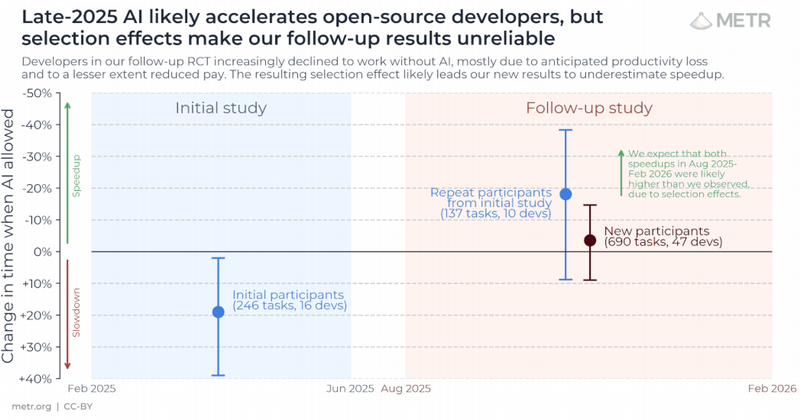
Let’s talk about a group of scientists who just announced that they are going back to the drawing board. AI followers are probably familiar with METR and their study late last year that found AI using developers were going 19% slower than their non-AI using counterparts, while believing they were being way more productive. Like good researchers, they had returned to this question when it seemed like new information arrived on the scene, namely Claude Code. Unfortunately, their most recent experiment ended up with a confidence interval that could have potentially wiped out their findings. With a technology as polarizing and click-baity as AI, it would have been easy to publish the results as is, get tons of attention, and let people sort out “the truth” for themselves. Instead, METR published their findings and explained that they weren’t happy with them and were going to work to create an experiment that would get us closer to a picture of reality. That’s a wise, long-game bet that the truth will go out.
The Bigger Pie Theory
We are going to wrap things up with an entire field that needs to start rethinking some fundamental assumptions. A core tenet of economics (regardless of political persuasion) is that supply and demand dictates that an “artificial” (aka public policy) increase in minimum wage will result in job loss. Here’s the thing: it just doesn’t. “The University of Massachusetts economist Arindrajit Dube and colleagues analyzed 138 state-level minimum-wage changes from 1979 to 2016 and found no evidence of job loss. Studies of 42 major minimum wage increases in metro areas that spanned state borders found employment growing on both sides, in fact slightly faster on the side that raised the wage.” Not only do jobs not vanish, but overall, the wage increases have positive knock-on effects for the communities where they are implemented, “The Federal Reserve Bank of Chicago found that low-wage households spent an additional $2,800 on average in the year following a $1 wage increase, stimulating the broader economy. And a 2025 study by the IZA Institute of Labor Economics showed that state minimum-wage increases meaningfully reduced poverty and food hardship, not just for minimum-wage workers but across the broader working-age population.” This signals the need for a paradigm shift in economics. The field does not actually study how economic actors divide up a static pie of resources because that’s not how the real-world functions. Given the opportunity, humans make more and bigger pies.