This edition of “Timely Innovations” is all about play. We are going to look at innovators who are leveraging play and passion to provide disaster relief and healing. This includes a stop at Atlanta’s own Georgia Aquarium. We will also be checking in on the innovators who are trying to shape the future of play by surveying the hottest AI-integrated toys and what they can and can’t do. Spoiler alert: it’s probably best to let them get a bit better before you get one for your kiddo.
Swimming With Whale Sharks for a Greater Purpose
Photo Credit: AP Byron Anderson
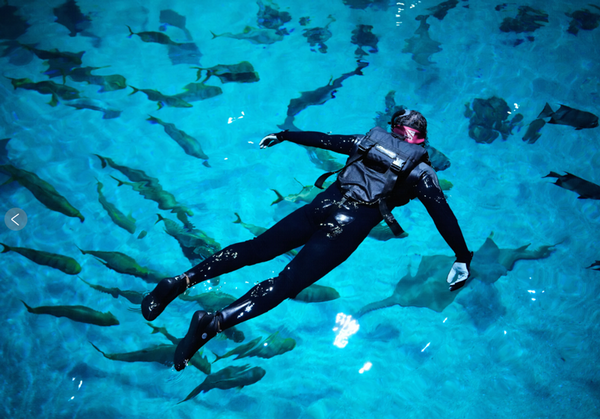
Let’s start with an Atlanta institution that is leveraging an in-house resource in a powerful way. The Georgia Aquarium’s Military Salute Program teamed up with the Wounded Warrior Project to give a group of veterans a powerful experience: swimming with Yushan, the aquarium’s whale shark. The swim has a positive impact on both the body and mind for the veterans, “They go in nervous and they come out saying it’s the best experience they’ve had in their life,” Jason Bush, head of the Military Salute Program, said. The program is a great example of each party collaborating in a mission-aligned way and putting existing resources to a good use. You may not have a whale shark laying around, but are there resources you have that could serve a mission aligned purpose with a collaborator?
Can AI Toys Actually Imagine?
Photo Credit: Alilo
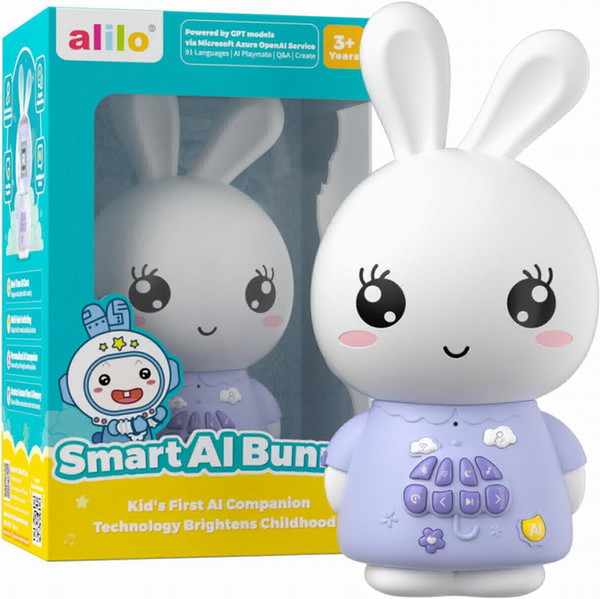
Wired recently took a survey of the cutting edge of AI-powered kid’s toys. It was weird. There were of course the usual concerns: AI deviating from child-appropriate topics, data privacy, emotional manipulation to extend engagement, etc. A surprising failure, given AI penchant for hallucinations was, as Dr. Emily Goodacre who authored a study on the topic said, “What we found was really poor pretend play.” For example, “Kids asked the Gabbo to pretend to be asleep or to hold a cushion, and the toy responded that it was unable to. One instance of ‘extended pretend play’ did take off—an imagined rocket countdown alternating between the child and the toy. Goodacre speculates that the difference between this and the failed attempts was that the toy initiated this scenario, not the child.” Given what two kids can imagine with a cardboard box or a pile of sticks, this is a real downgrade.
Origami, Disaster Relief and a 14-Year-Old Inventor
Photo Credit: Society for Science
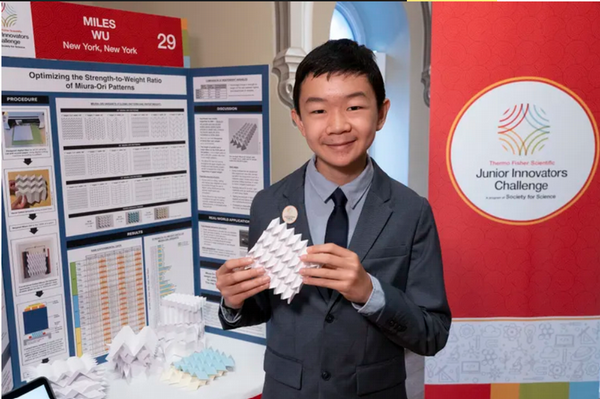
Speaking of the imagination of young people, 14-year-old Miles Wu has invented an origami fold structure that could be scaled up into super lightweight disaster relief structures. Wu was the winner of the Thermo Fisher Scientific Junior Innovators Challenge. Wu’s insight is a wonderful marriage of a personal passion of his (origami) and a real-world need, “Wu was especially intrigued by the Miura-ori fold, named after its inventor, the Japanese astrophysicist Koryo Miura. Famed for its use in aeronautical engineering… The pattern of creases and angles, which can be manipulated to create many variations, ‘Folds this really large sheet of paper into a really flat, compact shape, which I thought was really cool,’ says Wu. The teenager was researching the Miura-ori fold when Hurricane Helene made landfall in Florida and wildfires raged in Southern California. “I thought maybe these origami patterns, which are strong and collapsible, could be used as emergency shelters in these natural disasters—kind of like a tent,’ he explains. Wu noticed that existing structures were sturdy, easy to deploy or cost-efficient, but rarely all three. ‘This creates a problem during emergency situations, such as hurricanes or wildfires, as deployable shelters ideally need to be produced quickly, set up easily, and able to withstand the elements,’ he says.” While Wu’s invention can hold up on the small scale, there is a good deal of experimentation to prove out that it’s properties scale to real world application. Whatever is next for Wu’s invention, here’s hoping he keeps being led by his curious and combinatory mind.