The past ten years have radically altered the way we feel about social media. Countries all over the world are debating the role that social media and smartphones should play in the lives of their young people, with many countries deciding to greatly curtail that role. We wanted to highlight three stories this week that speak to our culture’s relationship with this technology. Each story shows us something about ourselves, a set of selfies if you will. What do you see?
The Search for a Simple Answer
It’s been hard to miss the stories about phone and social media bans. They have been happening across communities, school districts, and even whole countries. You may be familiar with one of the key players behind this movement, Jonathan Haidt. Well, one of the key players who deeply influence Haidt is about to come out with a new book, and he has some bones to pick with perhaps his most famous student. Psychologist Peter Gray’s concept of a play-based childhood deeply animates the smartphone resistance but Gray thinks we are in the midst of a
“moral panic” about phones. For Gray, the real villain stressing out our kids is the Common Core testing regime
whose rollout does indeed correlate with the rapid decline of kid’s mental health. Psychologist Candice Odgers rightly wonders if the idea that we need one, big bad explainer
is even the right way to think about our current situation. What does it say about us that we seem to long for a simple, singular problem, and are willing to ignore evidence that perhaps our problems are
wicked?
The Rise of Teen Takeovers
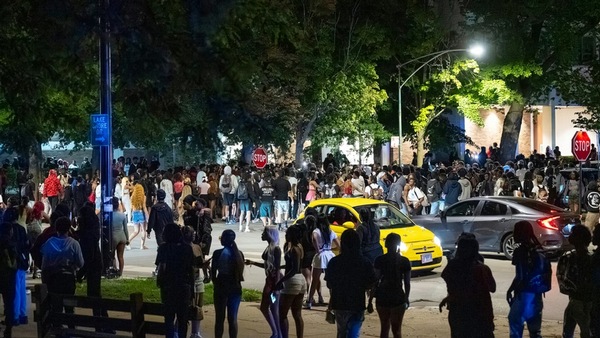
Our next story introduces another complex, social media and youth involved problem: teen takeovers. For the past year, a number of cities across the country have unexpectedly played host to large gatherings of teenagers in public places which have, in some instances, turned violent. The role of social media is extremely hard to ignore in these events. Not only are the platforms how young people find out about the events, it’s basically impossible to imagine their occurrence without the technology enabling them. You aren’t getting to this scale and spontaneity with phones alone. A key factor in these takeovers, writes
Robert Worth, are who and where they happen, “Most of the takeover participants I met in May and June were from D.C.’s poorest southeast wards, but that is not where takeovers happen. Instead, they usually occur in wealthier and more affluent urban areas, sometimes in restaurant hubs or public parks. That contrast can give takeovers the appearance of a spontaneous revolt, one that illuminates the extreme economic disparities of our era.” Additionally, they
coincide with record rates of truancy that have been elevated since the pandemic. They also seem to speak to a deep need that younger people have to gather together in-person in an unstructured way (see Peter Gray’s work above). Unfortunately, part of what makes these takeovers scary is conflict between police attempting to maintain order and the young people attending these events. Is “controlling” these events only making them worse?
The Year of the Misfit Mascot
Our final story is about another urban dweller causing a ruckus. We are pleased to introduce you to
Jimothy. Jimothy is a racoon with an abnormally short neck whose raids across Seattle have brought national admiration across social media. What is striking about Jimothy (besides his cryptid inflected cuteness) is that he has now joined a lineage of mischievous, underdog animals that have captured our attention over the past couple of years: Moo-Deng, Punch, Neal the Seal and now Jimothy. What does the virality of these misfits say about our collective mood?